Election resources
Stay informed on politics
We’re putting together policy analysis, scorecards, news articles, and more to make sure you have all the information you need to vote in the upcoming election.
2026 Disability Election Scorecard
Download text-only version (Word)
Download scorecard only (JPG)
Download scorecard and individual question tiles (PDF)
We’ve partnered up with Disabled Persons Assembly (DPA) and Your Way | Kia Roha to create a scorecard on disability-related issues. This is an easy way to see which parties are aligned with your values at a glance. Our organisations are politically neutral and have kept the information impartial so you can make your own decisions on who to vote for this election.
Illustration credit: Maioha Tawa
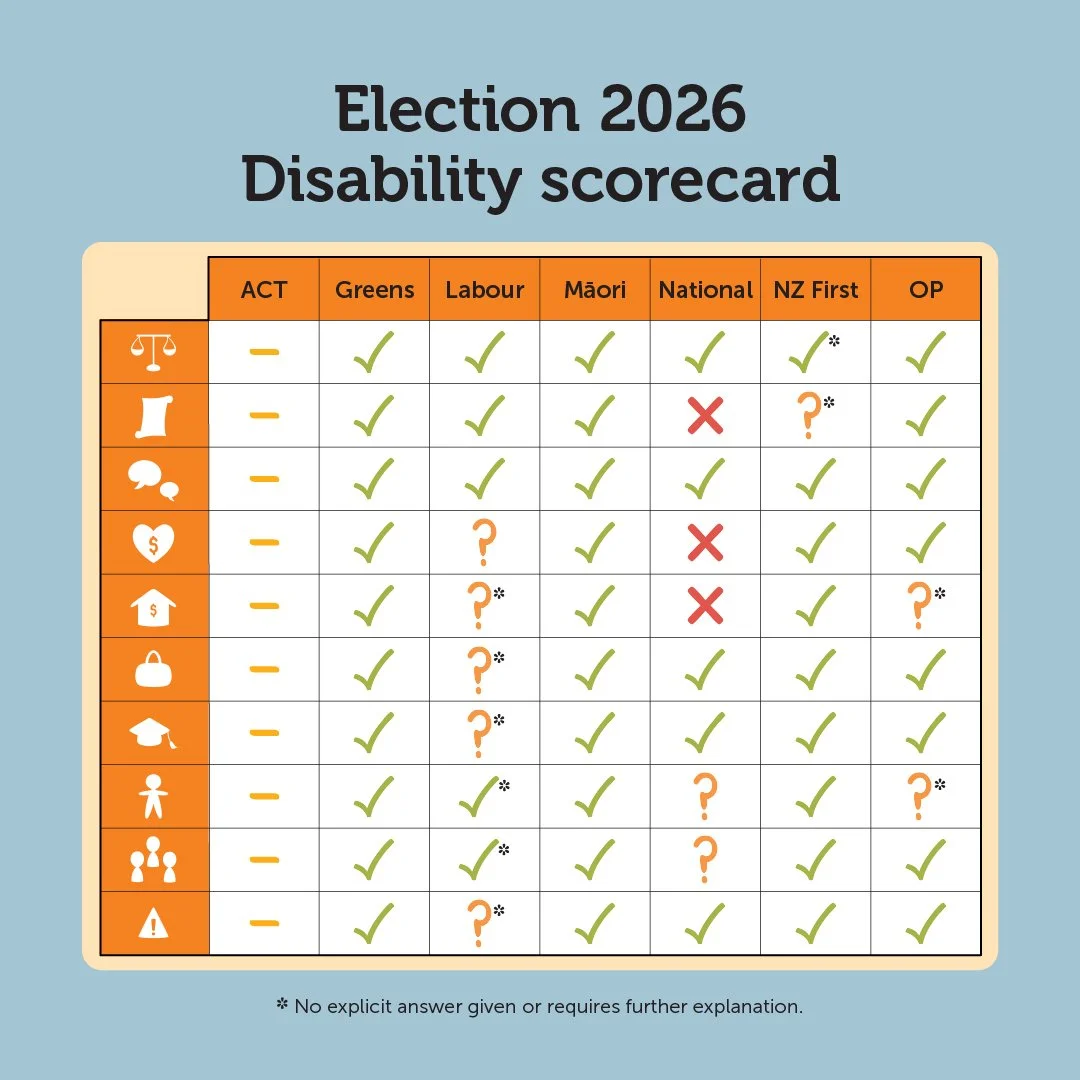
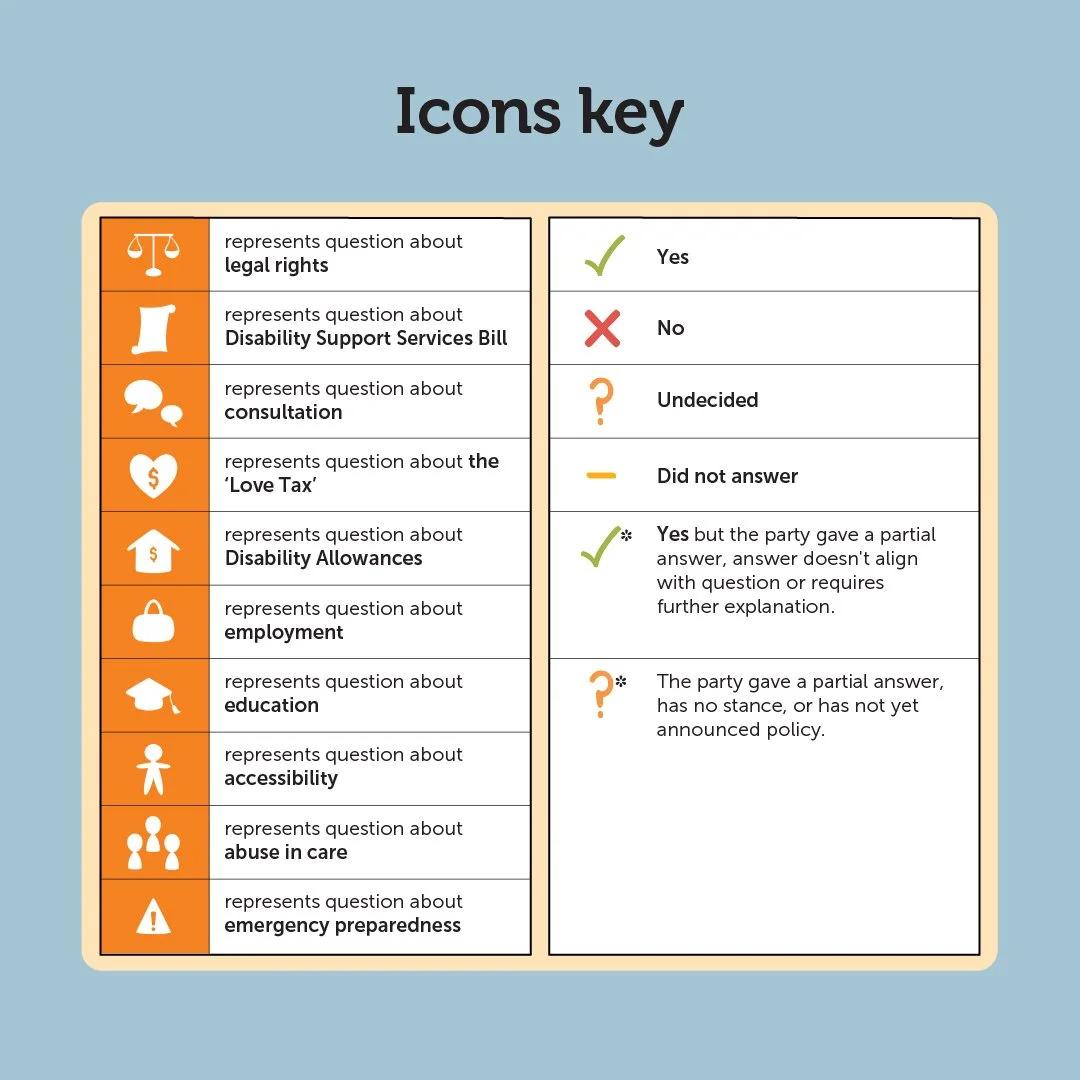
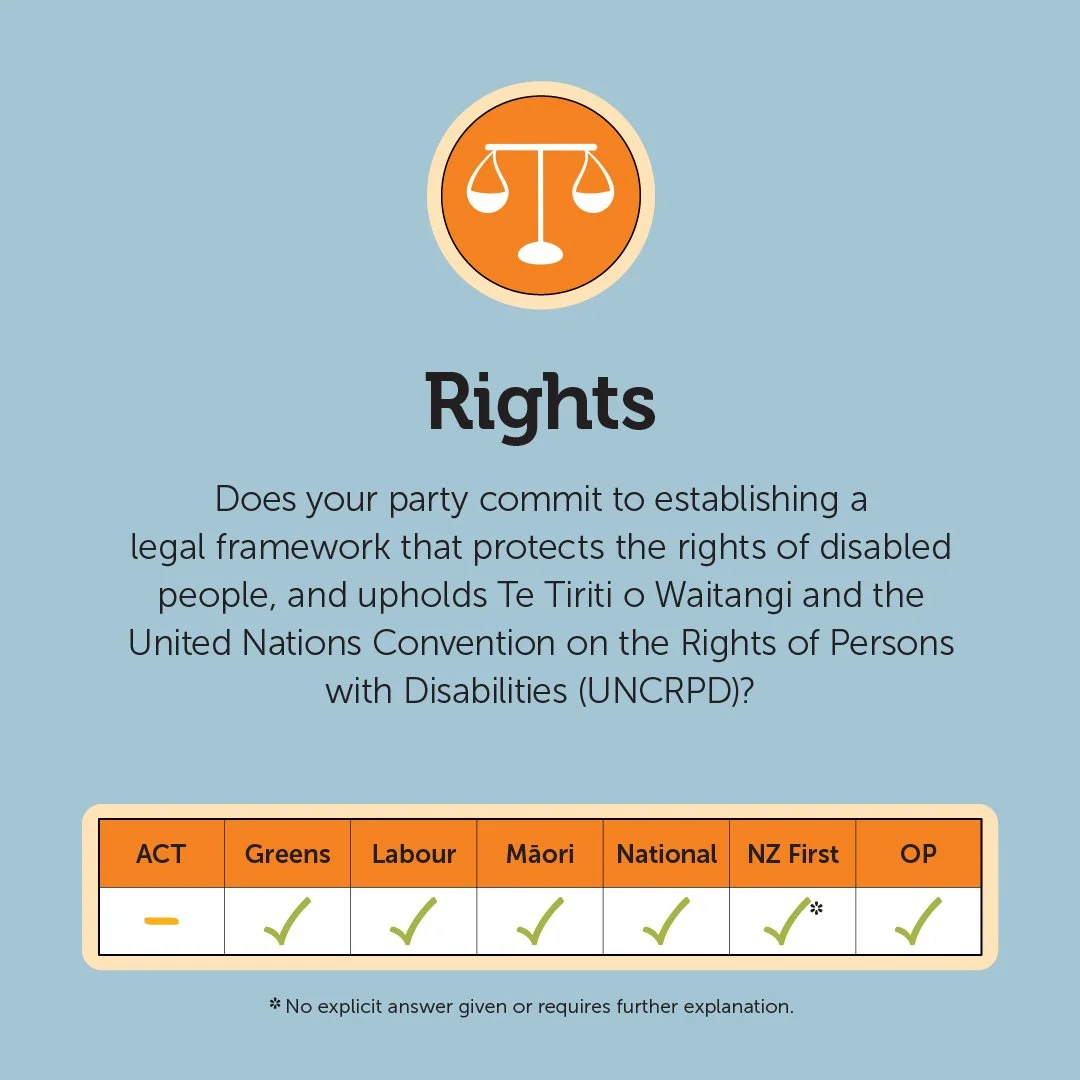
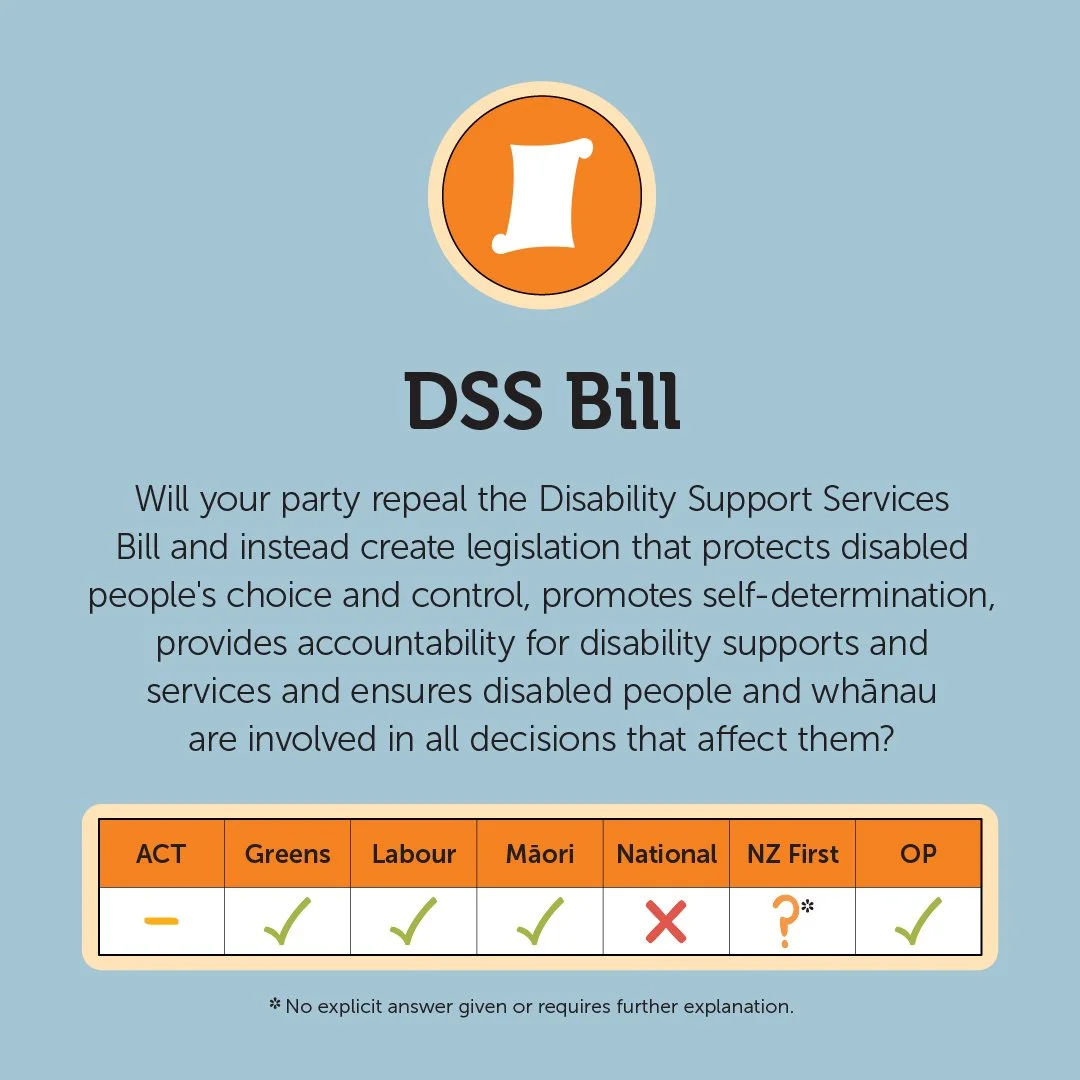
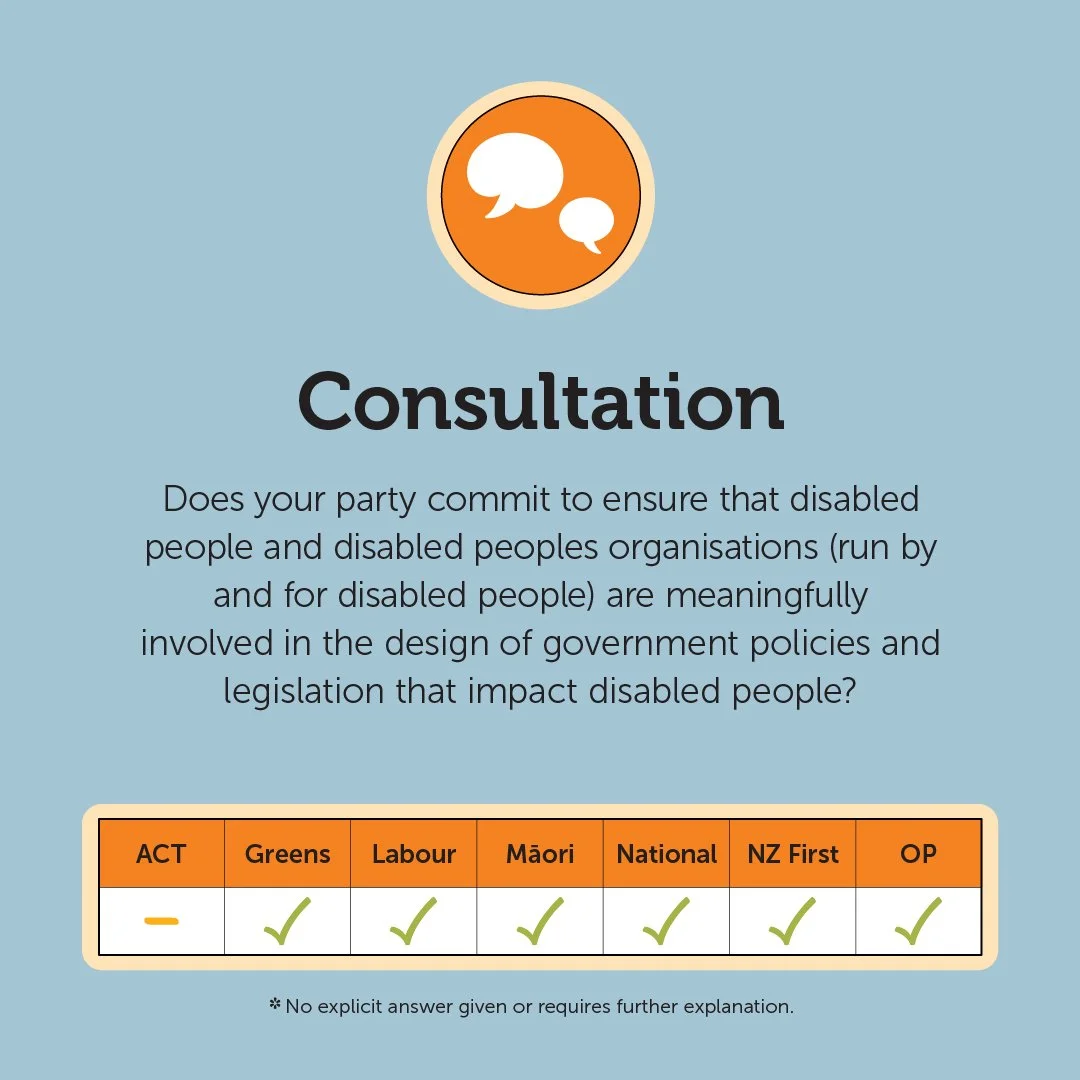
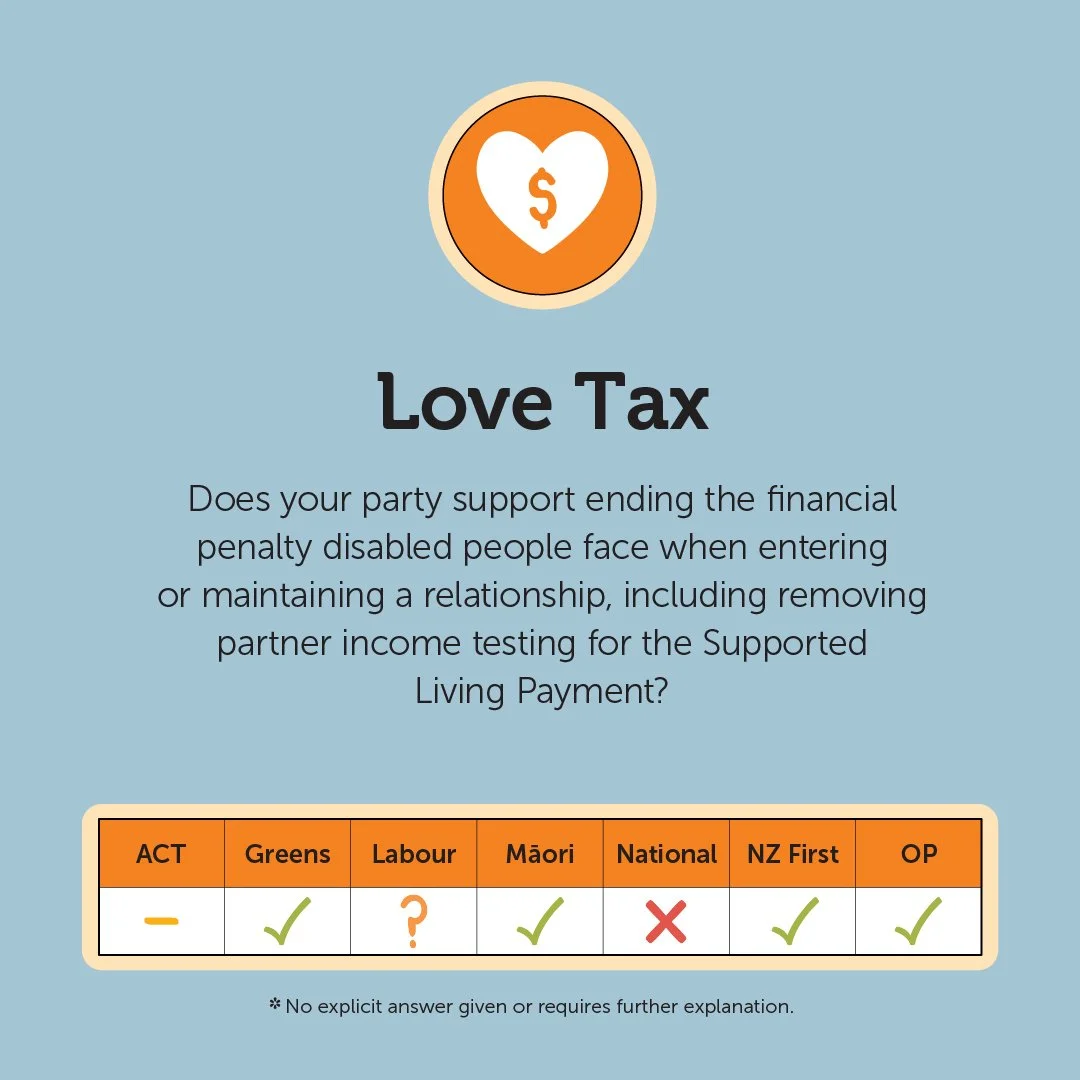
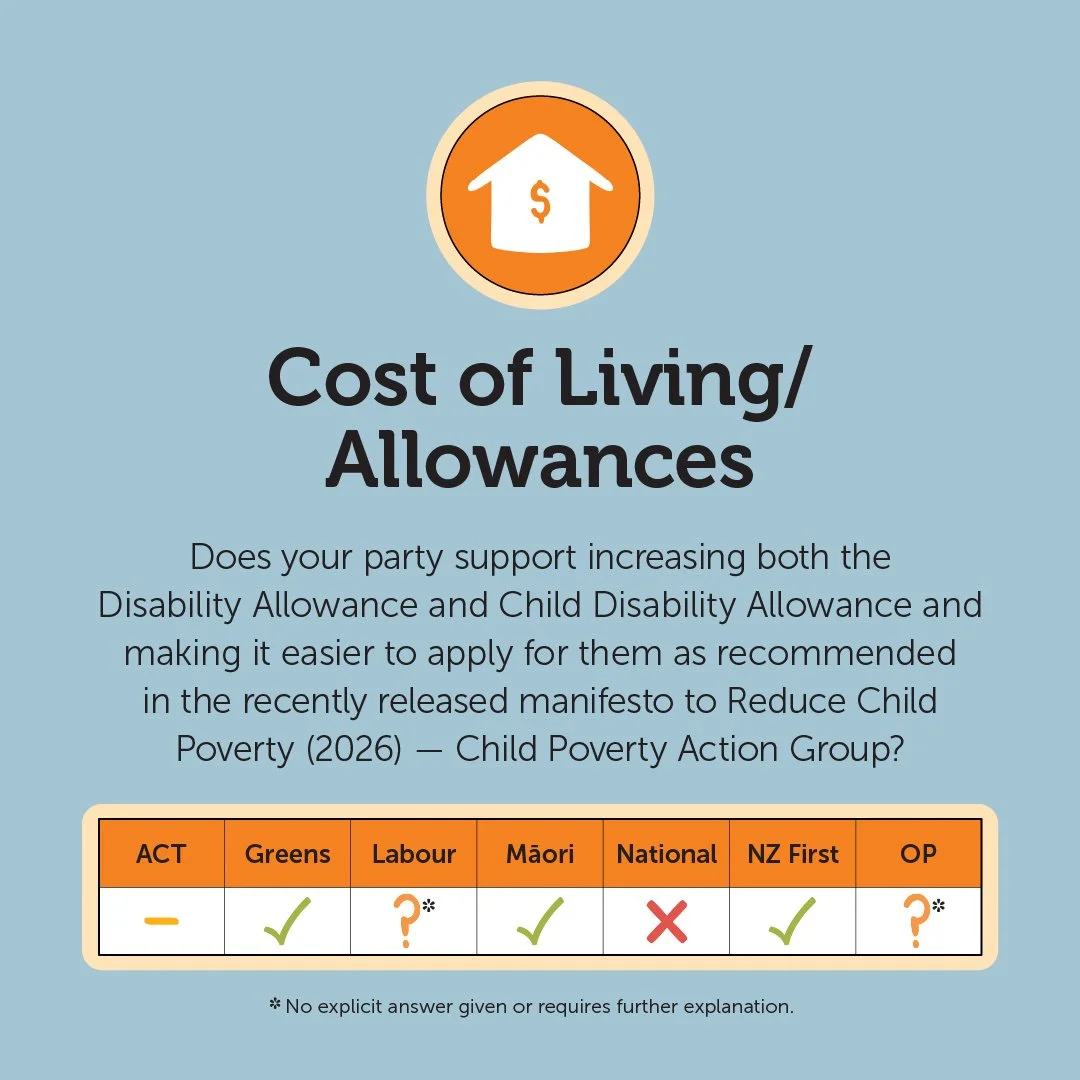
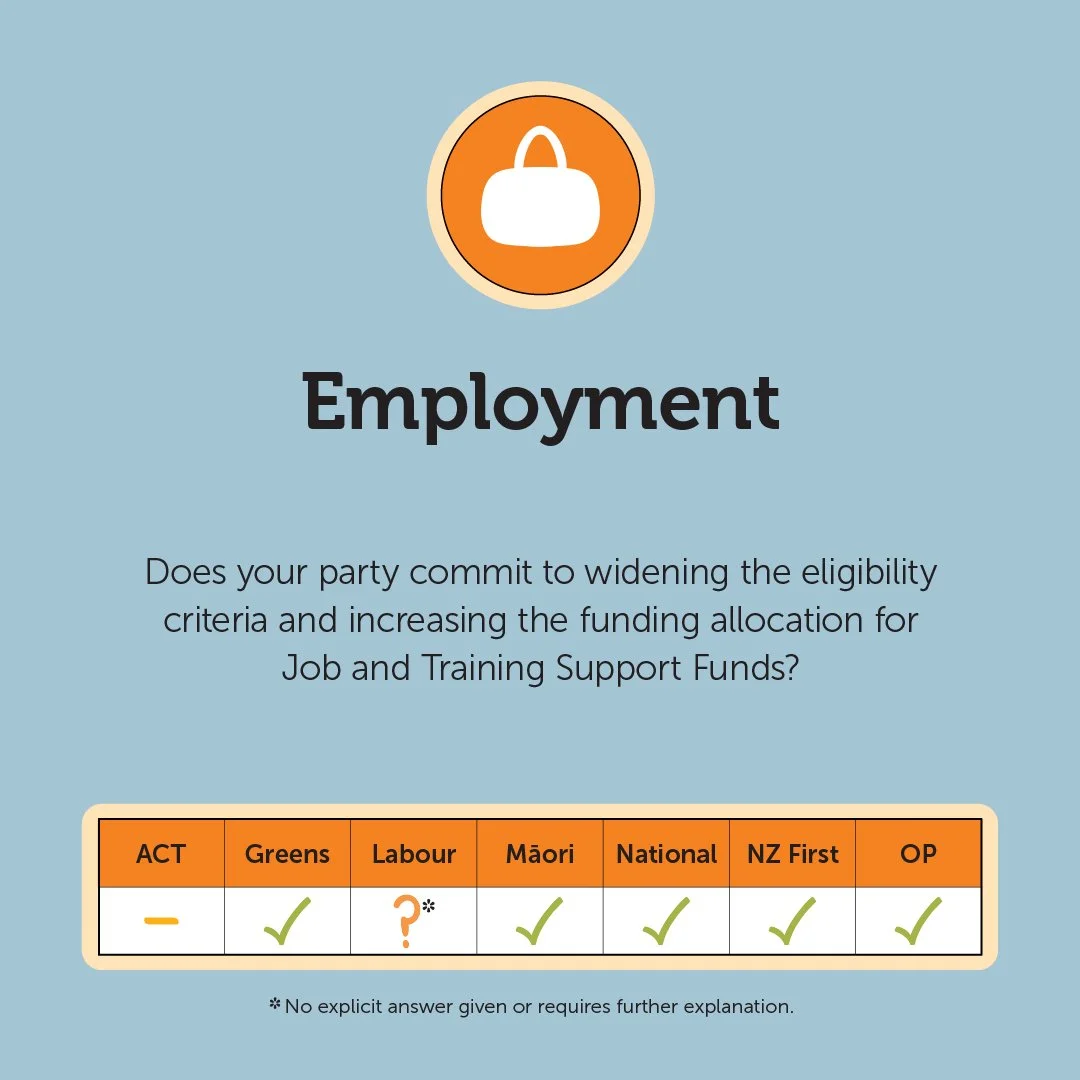
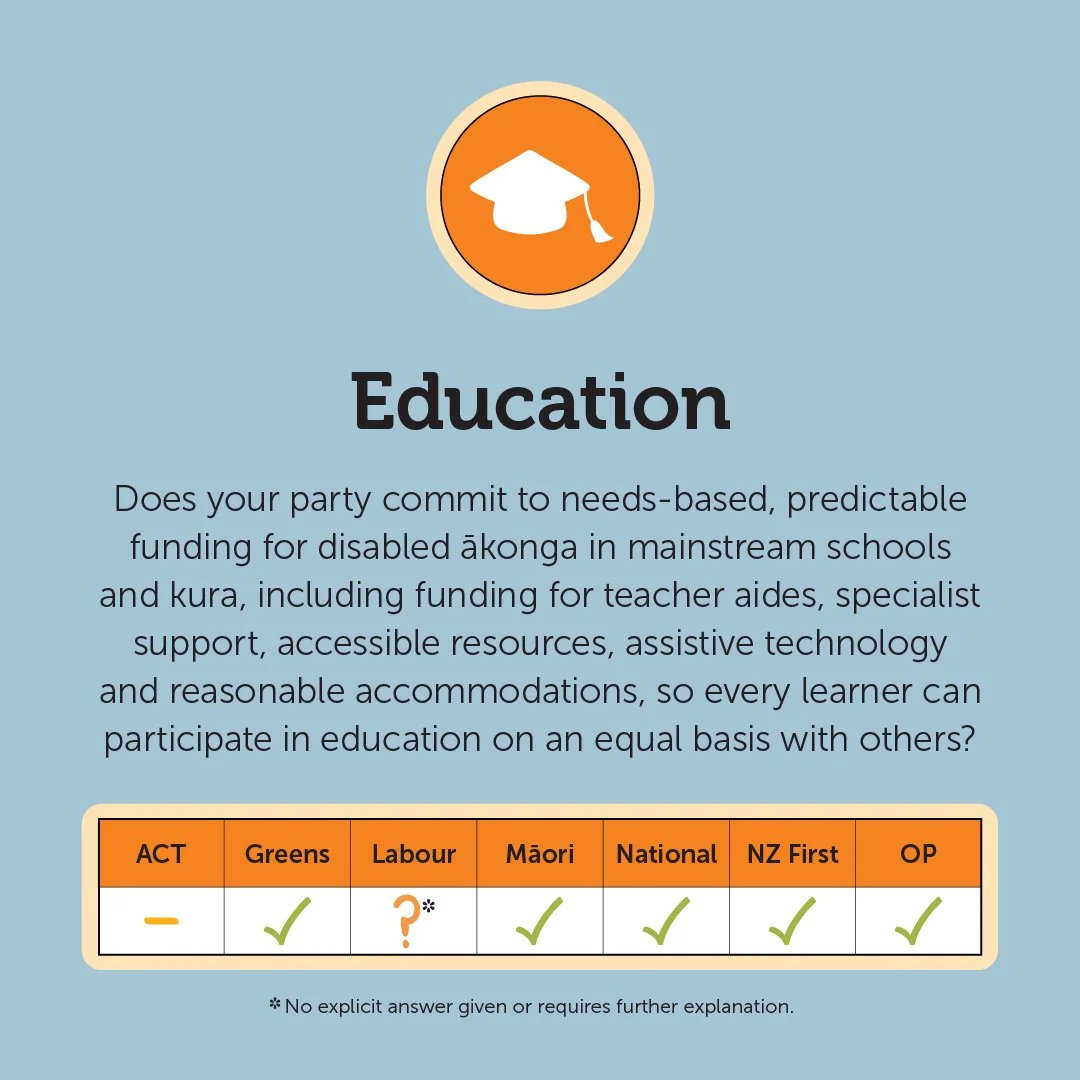
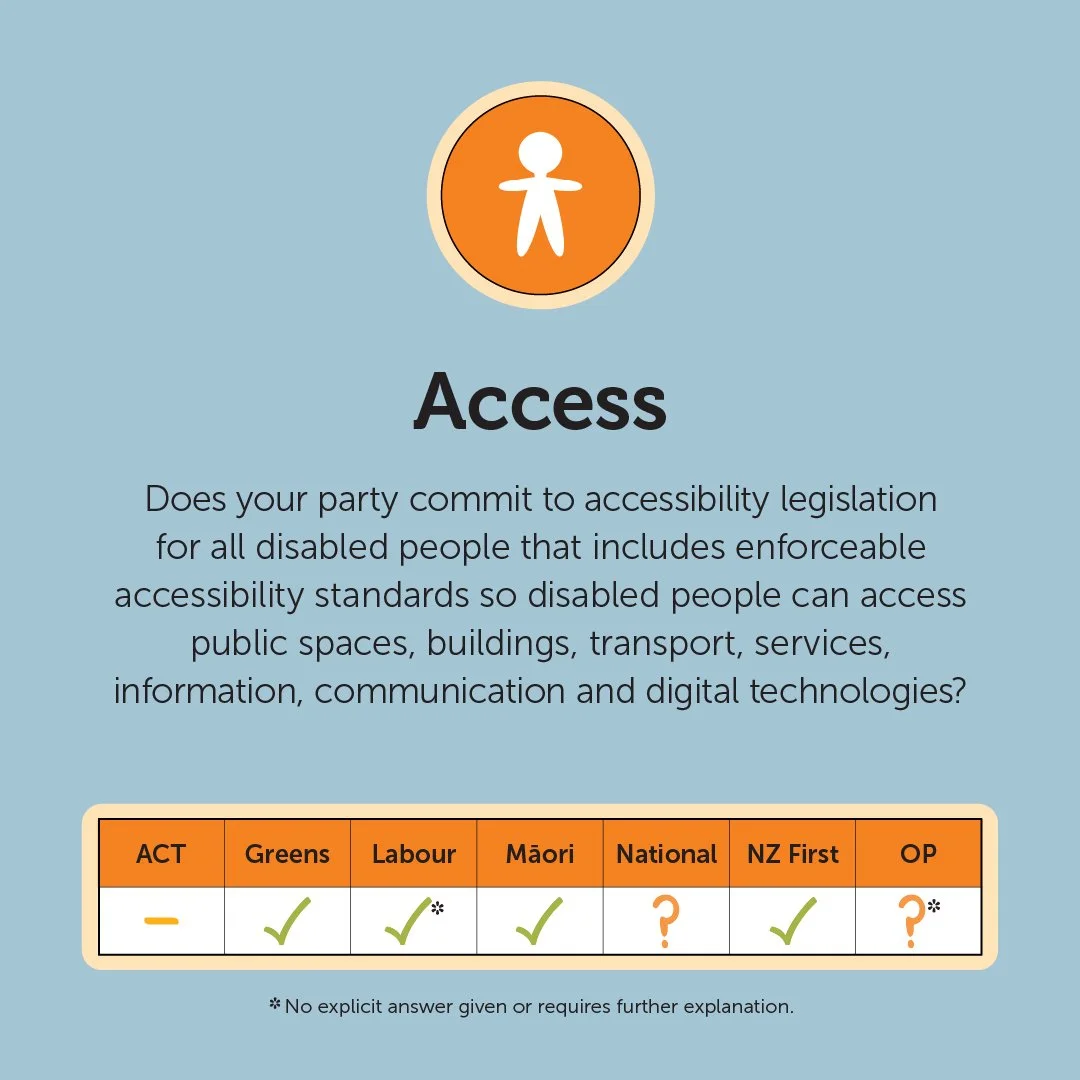
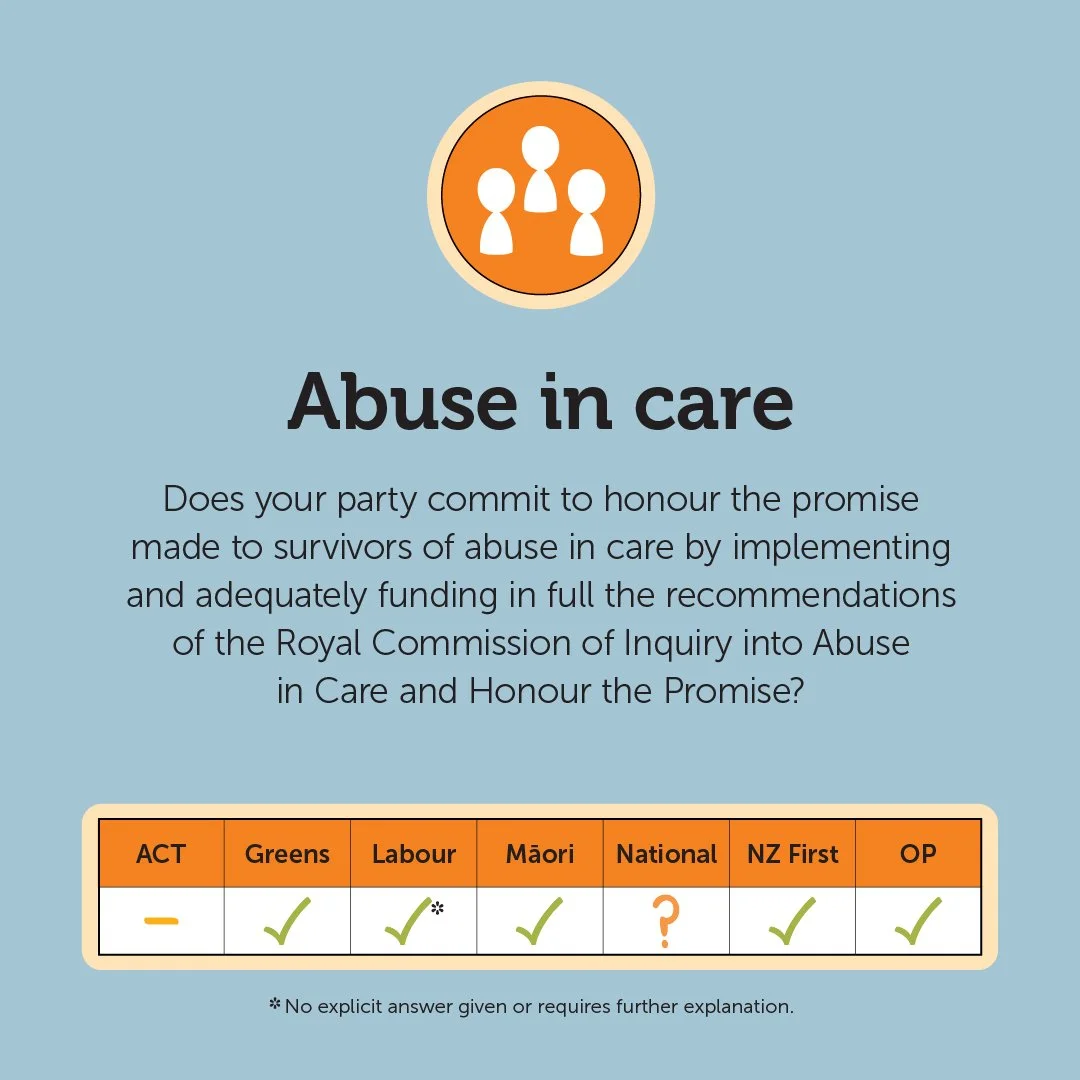
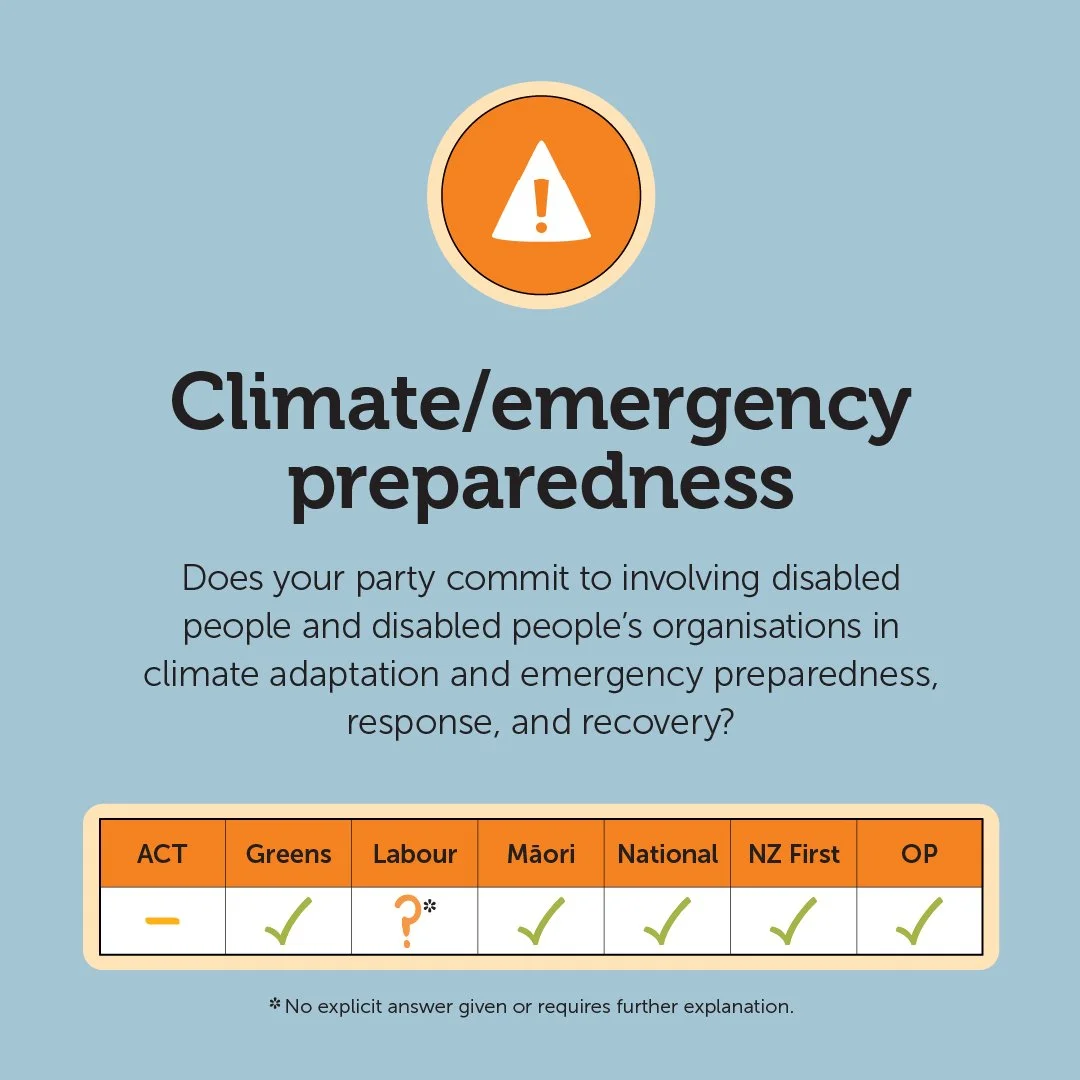
Image description: Set of thirteen images with a light blue and orange colour palette. Each has a light blue background and illustrations that have a hand-drawn feel. The first image is the scorecard: a table with white icons representing the topic on an orange background, and each party's response indicated by a yellow dash, green tick, red cross, or orange question mark on a white background. Second image has a key explaining the icons. The other images are the scorecard separated by topic. Each image has a header and question, with the responses inside a white box with rounded corners and an orange illustrated icon indicating the topic at the top. Final image has the words “Proudly created by” followed by the CCS Disability Action, DPA, and Your Way | Kia Roha logos. Below are the words “Illustrations created by Maioha Tawa.”
Method
We sent each of the main political parties (ACT, Greens, Labour, Te Pāti Māori, National, NZ First, Opportunity) a set of ten pre-determined questions in September 2026. All efforts were made to contact parties’ representatives.
Parties were given the option to answer each question with Yes, No, or Undecided. If they did not answer a question, or answered with something other than those three options, we marked this with an asterisk. Parties were given room to provide any additional comments at the end. These responses were collated into a scorecard, with the parties displayed in alphabetical order.
Answers are self-reported by the parties. We encourage you to further research their policies and commitments – stay tuned for CCS Disability Action’s policy analysis.
Parties’ additional comments
Question 1
Rights: Does your party commit to establishing a legal framework that protects the rights of disabled people, and upholds Te Tiriti o Waitangi and the United Nations Convention on the Rights of Persons with Disabilities (UNCRPD)?
Labour: The Labour Party is, and always will be, committed to good governance underpinned by the Enabling Good Lives principles, the UNCRPD, Te Tiriti o Waitangi and to ensuring that disabled people and carers are supported to thrive. We are committed to progressing work to incorporate the UN Convention on the Rights of Persons with Disabilities into law.
NZ First: NZ First supports protecting the rights of disabled New Zealanders and fully implementing the UN Convention on the Rights of Persons with Disabilities (UNCRPD). However, the party opposes incorporating Treaty "principles" clauses into general legislation, upholding equal citizenship under one law based on genuine need rather than race.
Opportunity: The Opportunity position statement explicitly recognises disabled people as rights-holders, recognises Te Tiriti, and commits to UNCRPD obligations.
Question 2
DSS Bill: Will your party repeal the Disability Support Services Bill and instead create legislation that protects disabled people's choice and control, promotes self-determination, provides accountability for disability supports and services and ensures disabled people and whānau are involved in all decisions that affect them?
Labour: Labour opposed the Disability Support Services Bill and will repeal it. Labour agrees that there needs to be a legislative framework for Disability Support Services funding. However, we do not support the Disability Support Services Bill as currently drafted.
We acknowledge disability communities for their strong submissions to select committee and worked hard to advocate for changes they wanted to see that would improve the Bill.
The stated aim of the bill was to increase consistency, fairness, and transparency for disabled people and their carers by introducing a statutory framework that is meant to “strengthen and stabilise the provision of disability support services”.
Yet bill it did not achieve its purported aims. The bill itself was not drafted with any input from disabled people, whānau, or carers. It is yet another example of this Government deciding they know what is best for disabled people and carers and ignoring the community’s rallying cry “nothing about us, without us”. That is why the Labour Party will repeal the Disability Support Services Act and work with disabled people and carers on a rights-based DSS framework that includes a focus on safeguarding.
NZ First: NZ First supports ensuring that disabled people and their families have real choice, control, and self-determination over their support services. The party advocates for flexible, person-centered funding models and informed self-assessment to facilitate independence rather than rigid central bureaucracy.
Opportunity: Opportunity has submitted on repealing the DSS Bill/Act. Opportunity was very critical of the Bill. Poorly drafted, absence of meaningful consultation, increased reliance on unpaid family carers, complete disregard for NZ’s international and Te Tiriti obligations. Opportunity would seek to replace it with rights-based disability legislation developed in partnership with the disability community.
Question 3
Consultation: Does your party commit to ensure that disabled people and disabled people’s organisations (run by and for disabled people) are meaningfully involved in the design of government policies and legislation that impact disabled people?
Labour: We remain deeply committed to ensuring that disabled people’s voices are heard when it comes to decisions that affect them. This is reflected in our ongoing commitment to the UNCRPD and the principles that underpin Enabling Good Lives and is why we will progress incorporating the UN Convention on the Rights of Persons with Disabilities into law.
NZ First: NZ First strongly supports consulting directly with affected communities and consumer organizations to shape disability policy. Under Principle 2 (Open, accountable government), the party holds that disabled people are in the best position to articulate their own needs and guide government decision-making in collaboration.
Question 4
‘Love Tax’: Does your party support ending the financial penalty disabled people face when entering or maintaining a relationship, including removing partner income testing for the Supported Living Payment?
Labour: We are committed to a system that supports and enables all disabled communities to thrive. That is why, for example, we will end annual benefit renewals for people with verified permanent disabilities. We have not yet announced our policies regarding benefits.
NZ First: NZ First supports a welfare system that acts as a fair umbrella for genuine need while encouraging personal independence and dignity. The party favours reviewing benefit abatement settings and income testing so disabled New Zealanders are not unfairly penalized when forming or maintaining relationships.
Question 5
Cost of Living/Allowances: Does your party support increasing both the Disability Allowance and Child Disability Allowance and making it easier to apply for them as recommended in the recently released manifesto to Reduce Child Poverty (2026) — Child Poverty Action Group?
Labour: We are committed to a system that supports and enables all disabled communities to thrive. That is why, for example, we will end annual benefit renewals for people with verified permanent disabilities. We have not yet announced our policies regarding benefits.
NZ First: Our past policy explicitly supports reviewing and increasing the Child Disability Allowance to ease the financial and emotional strain on parents raising children with special needs. The party also supports inflation-adjusting allowances and streamlining application processes so support reaches deserving families.
Opportunity: While Opportunity has no specific position, our Tax Reset policy proposes a wide-reaching reform of main and supplementary benefits to make them more accessible.
Question 6
Employment: Does your party commit to widening the eligibility criteria and increasing the funding allocation for Job and Training Support Funds?
Labour: We are committed to ensuring that people have better access to employment and training opportunities. The disability unemployment rate is far too high and we are committed to better supporting disabled people into better jobs. Labour will work towards systemic change so disabled people can transition into open employment. Labour is also committed to amending the Human Rights Act to define reasonable accommodation, and recognise that denying it is discrimination.
NZ First: NZ First places the employment of New Zealanders as a top planning priority (Principle 4) and pledged to reinstate Workbridge and it's encouraging to see more agencies supporting employment pathways and businesses stepping up through the New Zealand Disability Employers Network. But getting a job is only the beginning. The party supports expanding job and training support funds to assist disabled Kiwis into meaningful employment.
Question 7
Education: Does your party commit to needs-based, predictable funding for disabled ākonga in mainstream schools and kura, including funding for teacher aides, specialist support, accessible resources, assistive technology and reasonable accommodations, so every learner can participate in education on an equal basis with others?
Labour: We are committed to ensuring that disabled ākonga have the tools and resources they need to thrive in mainstream schools and kura.
NZ First: NZ First policy strongly advocates increasing Ongoing Resourcing Scheme (ORS) funding to cover high-needs learners, delivering Learning Support Coordinators, and establishing career pathways for teacher aides. The party is committed to resourcing mainstream schools, so every student receives predictable, tailored support.
Question 8
Access: Does your party commit to accessibility legislation for all disabled people that includes enforceable accessibility standards so disabled people can access public spaces, buildings, transport, services, information, communication and digital technologies?
Labour: We are committed to a system and services that supports and enables all disabled communities to thrive. We realise the importance of accessibility and the need for this to be prioritised. We have committed to domestic disability rights legislation and that will undoubtedly include a focus on accessibility.
NZ First: The party supports practical, enforceable accessibility measures that remove physical and social barriers for all disabled people. The party also introduced the Accessibility Standards Bill in the name of Jenny Marcroft to establish practical standards that identify, prevent, and remove avoidable physical, digital, and societal barriers in New Zealand.
Opportunity: While Opportunity currently has no set policy on this matter, we agree that all individuals should have equal access to all spaces and services, and would listen to disabled people and look at the evidence on how best to achieve that.
Question 9
Abuse in care: Does your party commit to honour the promise made to survivors of abuse in care by implementing and adequately funding in full the recommendations of the Royal Commission of Inquiry into Abuse in Care and Honour the Promise?
Labour: The Labour Party has committed to implementing the recommendations of the Royal Commission of Inquiry into Abuse in Care.
NZ First: NZ First stands firmly for justice, victim support, and holding institutions accountable for historical and systemic harm. The party supports honouring promises to survivors by implementing and adequately resourcing the Royal Commission’s recommendations to deliver meaningful redress and future protection.
Question 10
Climate/emergency preparedness: Does your party commit to involving disabled people and disabled people’s organisations in climate adaptation and emergency preparedness, response, and recovery?
Labour: Labour recognises the importance of meaningful engagement with disabled people and disabled people’s organisations in understanding and responding to the specific needs and experiences of disabled people in climate adaptation and emergency preparedness, response and recovery.
NZ First: NZ First supports integrating emergency management services and ensuring Civil Defence and regional response plans cover all community members. The party supports actively involving disabled people and representative organizations to ensure emergency preparedness, disaster recovery, and climate response plans meet accessibility needs.
Overall comments
Greens: The Green Party will build an Aotearoa where disabled people are valued and they and their whānau live with dignity and autonomy. An Aotearoa where disabled people and whānau have access to the services they need — like transport and good quality housing — means everyone can thrive in caring communities. Our current laws, policies and social norms mean disabled people are often denied the same rights as others and are excluded from places and activities non-disabled people take for granted. These barriers are often worse for tāngata whaikaha Māori and for disabled people from marginalised communities. The current Government has made it harder for disabled people to access the support they deserve and which enables them to participate equally in life and their communities. The Green Party is ambitious in its plan to create a more accessible Aotearoa by building on the Enabling Good Lives framework and grounding our approach in Te Tiriti o Waitangi. Our approach will operate on a high-trust model and apply to all disabled people, including those with disabling conditions who do not currently access support. The Green Party is committed to an Aotearoa where disabled people and whānau thrive in caring communities.
Labour: Thank you for reaching out to the Labour Party about our policies. Please note that the Labour Party is yet to release its manifesto and will do so in due course.
We have been an active advocate of disability communities throughout this term. We have been vocal right from the start – opposing the Government’s cutting of flexible funding, their arbitrary restrictions on residential care facilities, funding freezes, decision to stop the rollout of EGL sites, gutting of Whaikaha, moving DSS into MSD and more recently their badly drafted DSS Bill. We have also opposed the decisions they’ve made that have directly increased the cost of living for disabled people and reduced their rights.
We are committed to Enabling Good Lives principles, the UNCRPD, Te Tiriti o Waitangi and to ensuring that disabled people and carers are supported to thrive.
That is why the next Labour government will:
Work towards systemic change so disabled people can be better supported into employment
End annual benefit renewals for people with verified permanent disabilities.
Require at least 25% of new Kāinga Ora builds to be accessible.
Work with disability communities to build disabled leadership capacity
Amend the Human Rights Act to define reasonable accommodation, and recognise that denying it is discrimination
Progress incorporating the UN Convention on the Rights of Persons with Disabilities into law
Repeal Disability Support Services Act and work with disabled people, carers and disabled people’s organisations on a rights-based DSS framework that includes a focus on safeguarding.
We will release our manifesto in full in due course. We look forward to demonstrating that Labour’s long standing commitment to disabled people will guide the policies we will implement when in government.
Te Pāti Māori: Te Pāti Māori believes disability justice is a matter of mana, tino rangatiratanga and human rights. Tangata hauā, whānau hauā and Disabled People’s Organisations must be at the centre of every decision that affects their lives.
Our approach is grounded in Te Tiriti o Waitangi, the United Nations Convention on the Rights of Persons with Disabilities, and the principle that disabled people must be involved in designing, delivering and evaluating the policies, services and systems that affect them. We support Māori-led and whānau-centred solutions that recognise disability as part of the diversity and strength of our communities.
Te Pāti Māori will establish a Māori-led Mana Hauā Authority, strengthen accessible and inclusive education, improve access to culturally safe health and disability services, support meaningful employment opportunities, and ensure all new government-built housing is accessible. We also recognise unpaid care and whānau support as valuable labour and support income settings that enable disabled people to live with dignity.
Our vision is an Aotearoa where tangata hauā and whānau hauā can exercise choice and control over their own lives, remain connected to whakapapa and community, and thrive on their own terms..
National: National wants disabled New Zealanders to participate in their communities, live the lives they choose and thrive. Disabled people are experts in their own lives, and support should reflect their individual needs, choices and aspirations.
Since coming into Government, we have committed more than $2.1 billion in additional Disability Support Services funding across successive Budgets, removed the 2024 flexible funding purchasing restrictions, introduced nationally consistent needs assessments, refreshed the New Zealand Disability Strategy 2026–2030, and strengthened DSS legislation following more than 3,000 submissions.
Education is a particular focus. Every child should have the opportunity to participate, belong and succeed at school. We are investing more than $317 million in specialist education infrastructure, including 142 new specialist classrooms, three new specialist schools and major redevelopments at six existing schools. We are also investing in earlier support through Kaikaranga and Autism New Zealand, helping disabled and neurodiverse children and their families get support earlier.
Our wider focus includes removing barriers to employment, improving accessibility, supporting New Zealand Sign Language and strengthening safeguarding and review processes.
We know there is more to do. National remains committed to choice, control and certainty, and to building a sustainable system disabled people and their families can rely on.