
A work placement that’s a true ‘win win’
Some mornings in the CCS Disability Action Auckland office, the talking stops and everyone watches one person.
Savannah is at the front, shaping a letter of the alphabet, waiting while a room full of kaimahi try to copy her. Somebody gets it slightly wrong, but no one is worried. She goes again, because it's giving it a go that matters, not perfection. By the end of the session, the team can fingerspell their own names.
"I've really enjoyed teaching sign language to the staff," she says. "There’s been lots of laughter and enjoyment. It's been great."
Savannah is 31, lives in Henderson in West Auckland, and is on placement with the Auckland branch as part of her studies at AUT. She is Deaf and also has low vision.
She is the busiest kind of student. She is finishing a degree, learning from different team members and quietly working out what her career is going to look like.
She is due to graduate at the end of this year. She is clear on the impact she would like to make when she's done.
"Advocacy for DeafBlind people in New Zealand," she says. "There's very little resource here."
Six years, taken at her own pace
Savannah did not walk out of school and into a plan. She started studying six years ago, part-time, without knowing where it would lead.
"I didn't know what I wanted to do for my future," she says. "I knew I wanted to learn about my identity, so that's where I started."
She began with a diploma in Deaf Studies. It covered New Zealand Sign Language (NZSL), Deaf identity, deafhood, Deaf values, and advocacy for equity. She finished the diploma and started looking for work.
Unfortunately, the work did not come. Applications went out and nothing came back.
So, she went back to university and enrolled in a Bachelor of Arts in Deaf Studies and Social Science, which turned out to align well with what she had already been studying. Government. Advocacy for equity. Racism. The education system.
With English as a second language, NZSL being her first, Savannah has paced her studies to suit her needs.
"I was aware that full-time would be hard for me," she says. "It's been easier for me by taking my own time. The language is always a high register at university, so I take my time to go through all the material."
That approach has done exactly what she needed it to do.
"I know that I can do university-level work," she says. "Before, I was uncertain about that."
Learning in both directions
The introduction to CCS Disability Action came through a lecturer in the Deaf Studies programme, who knew someone working at the Auckland branch.
That someone was Margaret, a Senior Coordinator who had also come through Deaf Studies and is hard of hearing themself. Margaret and the team built a placement around what Savannah needed: exposure to real work.
Savannah has been based with the Youth Development and Adults Team in Tāmaki Makaurau. She shadows kaimahi, so that she can learn the different roles and understand how disability funding and support works in practice. She visits disabled people in their homes. She has also spent one-on-one time with the team's Service Manager, learning about the Community Participation contract and the supports it funds for disabled adults.
"I've enjoyed visiting people in their homes," she says.
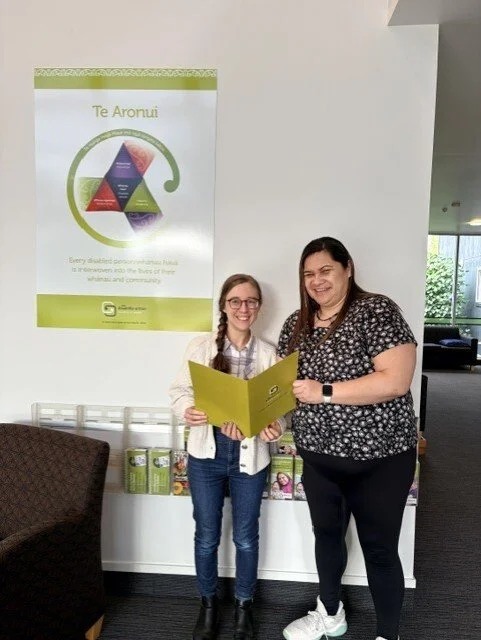
Senior Coordinator Sharleen Tongalea has worked closely with Savannah throughout.
"Savannah is a delight to have in the team. She always brings a bright smile and a laugh," Sharleen says. "It has been a pleasure to watch her absorb the knowledge, and keep learning how we deliver services and supports here in Tāmaki Makaurau."
Ask Savannah what has surprised her most and she comes back to how much she did not know.
"Before CCS Disability Action, I didn't know too much about disability," she says. "Having come here, I've learned a lot about the variety of disabilities out there. It's really opened my mind. I'm thinking about all the different barriers people face, and how those barriers can be removed."
The part of the mahi that has stuck with her is what happens when someone's support is cut.
Savannah has watched coordinators pick up the phone after a person's funded support hours are reduced, and work to get those hours restored.
"Then we can advocate to see what we can do there," she says. "CCS Disability Action tries to advocate the best they can to bring it back up."
The learning has gone the other way too. Savannah has run NZSL sessions with the team, adapting to how people wanted to learn: one-on-one where staff wanted that, and the alphabet delivered in team meetings.
"She has reinforced the importance of learning NZSL," Sharleen says. "The team have learnt how to sign their names, and her presence has created more disability awareness and education."
Well supported, both ways
Margaret was Savannah's go-to person at the start. With Margaret currently on leave, Sharleen, who has a vision impairment herself, has picked up the mentoring.
Being mentored by two disabled people is not a small detail. It is one thing to read about disabled leadership in a lecture. It is another to see it in action around you.
"I've definitely felt welcomed here," Savannah says.
Sharleen is clear that the benefit has run both ways.
"It's always a real privilege to support another disabled person on their journey through life," she says. "I've really enjoyed spending time with Savannah and learning how to make sure her access needs are followed up, not just in our team and branch, but right through our organisation."
"I would also like to thank all the NZSL interpreters who have supported the placement and allowed us to connect with Savannah daily," Sharleen says.
What comes next
Savannah would like her next steps to involve advocacy work with and for DeafBlind people. She points out that Australia and parts of Europe have far more resource for DeafBlind people than New Zealand does, and puts it partly down to population and partly down to stronger legislation.
Outside of study and placement, her life is full. She walks in the bush. Her faith is very important to her. She bakes, mostly cakes. She goes out with her friends. She travels overseas when she can. At the moment she is looking for a flat, because she still lives with her family and would like her own place.
Her advice for other Deaf and disabled students is practical.
Start where you can manage, she says. Go part-time if full-time is too much. Give yourself the extra time to get through material written in language that was not designed for you. The pace is nobody else's business, and it does not make the outcomes any less satisfying.
"I thought it would be too hard," she says, "but I've been successful, so others can be too."
She has a few months of study left, colleagues who value her contribution and a very clear idea of the work she wants to do next.
"We wish Savannah every success with her journey," Sharleen says.
Here's to Savannah making those hopes a reality.
About CCS Disability Action
CCS Disability Action is the largest pan-disability support and advocacy organisation in Aotearoa New Zealand.
We support people with all types of impairments and have been working alongside disabled people since 1935.
We are at the forefront of service provision, advocacy and information sharing in the disability sector. We partner with disabled people, their families and whānau to enable them to have choice and control in their lives. Our vision is to see every disabled person and whānau hauā interwoven into the lives of their whānau and community.